Tag Archives: places to explore in North Dakota

Telling The Secrets Of North Dakota

On Monday morning I telephoned my father in North Carolina, and right away he was yelling at me, “You better stop that!  I’m telling you, you, hey, I mean stop!”  I had no idea what he was talking about or what he was referring to.  He was mad that I wrote not only one, but two blog posts about the forested valley on the Fort Berthold Reservation.

My father was sure that I was going to cause every developer on the east coast and the west coast to fly out there tomorrow to buy up all the land.  I tried to explain to my father that it was Bureau of Land Management land, or Native American land.  He said, “So what, BLM does lands swaps all the time.  The Native Americans will get talked into building a casino there, and it will all be ruined.”

I felt that I had been vague enough about the location, that only enthusiastic hikers would be able to find it.  But my father disagreed with me, the developers will find it now.

The way I feel about it right now, what if only a few people get to see it this year, and a few people next year, what good is that?  I had never seen anything quite like it in my life, and it made a profound impression on me.  In my excitement and happiness, I wanted to tell other people, but I was aware that making it too easy to find could ruin it.

I really don’t want hunters to go there.  Hunters are the most ignorant piece of shit people, not even recognizing their own mental deviance and defectiveness in getting excited by the thought of killing animals.  I try not to hit birds, squirrels, turtles, dogs, cats, and deer with my vehicle, but hunters get excited about killing these animals and they actually go looking for them in order to shoot them.  Currently all the animals in this valley are unafraid of people, only slightly wary of people, and I don’t want hunters to terrorize the animals.

I also don’t want the meth addicts to go there.  I would hate to see beat up Hyundais there with Idaho license plates beginning with the letter “K”, for Coeur D’Alene, meaning that there are restaurant and bar workers there that are high on drugs and looking for things to steal.

When I sat in the valley, it was quiet and peaceful, and amazingly beautiful.  There were no people and no vehicles, it was completely serene.  The sight of it, and the experience of it, made everything else seem insignificant and unimportant.  For as long as you are there, nothing else seems to matter.  Whatever might be important elsewhere, is no longer important.  The amount of money in your bank accounts, the amount of your debts and bills, your career, your job, your house, your car, your possessions, your successes, your failures, none of it matters because it is all so insignificant in comparison to what you are now seeing and experiencing.

Ever since the white settlers came to North America, they considered the Native Americans to be very odd in regard to the ownership of land.  The Native Americans did not have the concept of owning land.  Even in present times, Native Americans differ from white people in the way they live and what they own.  White people would characterize Native Americans as being careless.

When I sat in this valley, I partly understood why the concept of owning land may be ridiculous to Native Americans.  How could a person own this, it has existed for thousands of years before a person was born, and it will exist for thousands of years after a person has died?  How could a person try to control every animal that dwells here, and every animal and person that passes through?  Would it not be insane, and the action of a crazy person, to even try or think that they could control what goes on here?  What are you going to do, stop the rain, wind, snow, fire, drought, flood, birth, and death?  If you think about it, white people do have the belief that they can, and must try to control everything.  White people never fully grasp the truth that they are here for just a very short while, and are insignificant really.

I would like for other people to find the forested valleys on the north side of the Killdeer Mountains, and be able to experience this one or more times, while it still exists.  Jackson Hole has been ruined, Flagstaff has been ruined, and Sedona has been ruined by the millionaires and the billionaires, that thought that they could buy up paradise and own it.  Instead they choked the life right out of it, almost like the tale of killing the goose that laid one golden egg each day, in order to try to get all the golden eggs at once.  This is one last chance that I know of for people to experience the most beautiful land that I have ever seen.

The Native Americans control this area inside their sovereign nation of Fort Berthold, whether some of the land is owned by the Bureau of Land management or not.  If the Native Americans want to develop this land, it would be a shame, but their right to do so.  They don’t have to preserve their tribal land for the sake of white people to come and visit, white people really aren’t supposed to be here on their reservation in the first place.

Because of the Native American’s “odd” view on the ownership of land, they aren’t currently chasing down non-trouble maker white people during the day that might be hiking or bicycling.  However, about 5% of Native Americans will kill white people if they catch them on the reservation at night, or the Bigfoots will.
The Most Beautiful Land I Have Ever Seen

In the past six weeks I have written several blog posts about my new job.  I had been working on oil well locations in the Fort Berthold Native American Reservation.  Once I knew my co-worker/supervisor well enough, I showed him the Bigfoot sighting reports on the Bigfoot Field Researchers Organization website for Fort Berthold.

Within a few weeks, we were headed to a very remote location where my co-worker/supervisor had in the past gotten so spooked, that he left the location without completing the work.  Once it became dusk, he felt that something was watching him from the trees, the hair on the back of his neck was standing up, he couldn’t take it, and he got in his truck and he left in a hurry.

As I was driving the crane truck following my co-worker/supervisor to this location a couple of weeks ago, I was becoming more and more amazed at the number of trees.  There are very few trees in western North Dakota, and there are never enough to make a forest, but we were entering a forest.  We were winding back and forth around corners, and suddenly we were above a valley that was completely and densely forested with trees.  I couldn’t believe it.

When we got to the location, it was at the dead-end of the road.  I had a lot of questions for my co-worker/supervisor, I had never seen anywhere like this in North Dakota, neither had he.  We got in his crew truck and we drove down a fork in the road, into the valley.  The trees were as close and dense as anywhere I had ever seen.  In some places you could not see further than ten feet into them from the road they were so thick.  We stopped a few places to look across tall grass meadows to the eroded sandstone cliffs on the other side of the valley.  We saw a small herd of wild horses.

I knew that I would want to come back to this place when I was not working, but this could be a problem for me because I am not supposed to travel wherever I want on the Fort Berthold Reservation when I am not in a company vehicle with the $2,500 bright orange Taro sticker on the door.  We looked at an oil company map, and there was some indication of Bureau Of Land Management land in this area, so I should be able to drive to BLM land legally.

I did not have to work on Friday July 14, so I planned on coming back to this land on this Friday.  I purchased a Dash Cam video recorder for this trip, to record the drive into this valley because it might be the only chance I will ever have to come back, no one will likely believe or understand what I am describing, I wanted a video for myself and to show other people.

While doing some reading about Dunn County before my trip, I read that there is an area in northwest Dunn County that has a mini-ecosystem that is like nowhere else in North Dakota.  This area is in a valley, and it is densely forested with Burr Oak and Aspen trees. Yes, yes, that is what this area is like, it is like nowhere else in North Dakota.

I also read in the history of Dunn County, that in the late 1800s the U.S. Army/Cavalry discovered prospering Native American villages in valleys on the north side of the Killdeer Mountains.  There were several thousand Native Americans living there, hundreds and hundreds of lodges and teepees.  The U.S. Army/Cavalry reported destroying most of the lodges and teepees, destroying a great number of their supplies, including “the burning of 200 tons of dried buffalo meat”.  The valley that I was in, was so green and lush with vegetation, that I can understand and imagine that thousands of Native Americans could flourish in this area, much more so than on the open grassland.

I was excited about getting back to this valley.  I was driving my four wheel drive Toyota truck, I had my Dash Cam video camera on and recording, I had drinks and food, binoculars, rifle, sleeping bag.  I planned on staying there overnight.  I didn’t take any wrong turns, and I found the road that I was looking for into the valley at 4:00 p.m.  I drove slowly because I wanted to look at everything, not miss anything, and I wanted to get good video footage with my Dash Cam.  I had plenty of time.

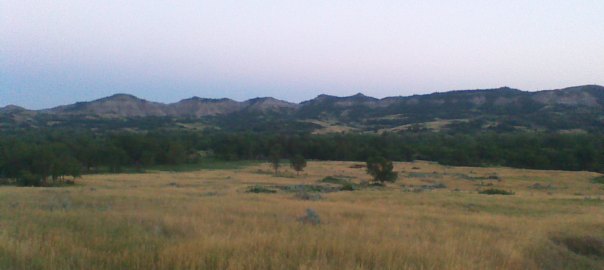
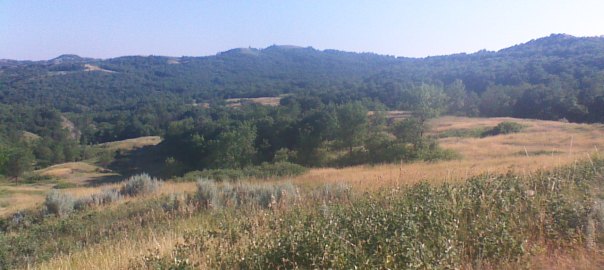
On the way in, I saw some small groups of free range cattle, and some small groups of wild horses.  I went further into the valley than I had gone before.  About eight miles further in, the valley opened up into an even larger and longer valley, which I believed must have been the Little Missouri River Valley.  This was the most beautiful land that I had ever seen.  The Killdeer Mountains were the southern wall of this long and wide valley.  High on the Killdeer Mountains there were green belts of trees, probably Cedar trees.  Lower on the Killdeer Mountains there were green meadows, Aspen trees, and then lower Burr Oak, and I believe Cottonwood trees.  You could tell where the Little Missouri River was by the darker green and denser trees and vegetation.

I stayed in the valley and drove in the valley until 10:00 p.m.  The whole time I did not see another person or another vehicle.  It was amazing to me that I was in the most beautiful and undeveloped spot in North Dakota, and nobody knows about it.  I parked my truck behind some trees and I hiked up about three hundred feet above the valley.  It was very quiet.  I was neither hot nor cold, and insects were not bothering me.  This month of July has been pretty dry for North Dakota.  But this valley was very green and it had water in it.  I could see and understand how this valley must have been very idyllic for the Native Americans who lived here hundreds of years ago.  Sheltered from the heat and drought in summer.  Protected from the cold, snow, and wind in winter.

Even though this valley is in the Fort Berthold Native American Reservation, plains Indian tribes were probably living in this valley one thousand years ago, way before there were any reservations.  I have read and heard the North Dakota Native Americans complain about the Killdeer Mountains being sacred, and not wanting any development here.  I sat there and I thought about the word “sacred”.  It had in the past seemed to me to be a misuse of the word “sacred” to describe land.  Now, I understood.  This land was more beautiful than the ski resorts in Colorado, more beautiful than the mountains in Flagstaff, or the red rocks in Sedona.  This valley must have been almost a utopia for plains Indian tribes for a thousand years.  I can see that now, and I can understand now that it is not replaceable if it becomes developed.

I may give some hints on how to get here, I might have given enough already.  It may be better for anyone who is very interested, to find these valleys for themselves.  I don’t want to give explicit directions on how to get here because I don’t want the wrong people, like developers from New York or California, or Meth people to get here.

I have more photographs that I would like to show, so I will include these in an upcoming blog post.  Here is one video of this area, taken from one of the highest points, but this video does not really show the denseness of the forests below:


This second video, shows more of what the forests look like: